
Who Are We?
MAGA, Zionism and the moral absurdity of "Blood and Soil"
As I write, highly uncivilised human beings are flying over the Middle East, indiscriminately killing people in my name.
Back home, Alana Newhouse of Tablet Magazine, the voice of conservative American Zionism, published an article titled “Zionism For Everyone” in which she concocts an apology for Jewish supremacy that is barely distinguishable from SS Obergruppenführer Richard Walther Darré’s A New Nobility of Blood & Soil (which I have read so you don’t have to). Am I surprised? No, I am not.
It’s not even worth going into the details of Newhouse’s argument since it is so disingenuous, though I will say that I think comparing zionists to Nazis is usually a lazy polemical manoeuvre that obscures more than it reveals. We should read and understand the monstrous arguments of the nineteenth and twentieth centuries to better refute them and ensure their exclusion from political and cultural considerations, not use them as abbreviations for “bad”.
In this case, I make the comparison because the arguments of Newhouse and Darré share the same origin in völkisch nineteenth century notions of “peoples”, of ethnic identities and nations, and mystical ties to the lands they claim to have inhabited since antiquity, even if this continuity exists only in the imagination of its authors.
Apologies for ethnonationalism rest on the axiom that a group of people who consider themselves as such—by virtue of language, religion, ethnicity and race—are a people entitled to self-determination, which in the modern struggle between nation states means civil, political and military control over a specific land area. Ethnic nationalists contend that the people belong to the place, and vice versa.
You can probably see immediately how this not only animates Zionism but also implicates the best-intentioned arguments in defence of Palestinians and their right to the land occupied by Israel. Setting that implication aside for the moment to focus not on ideas but rather the concrete and bloody reality of putting these ideas into practice, the tautological problem arises: which people are the people?
Many people consider themselves to be Americans (or English, or Scots, or Germans, or Chinese, or Russians, or Sudanese, or Kurds, etc.), while some would argue that not all of them actually are. Likewise, some factions deny being part of the group at all—they see themselves as a different body altogether and their unwilling incorporation into the group as oppression. So right off the bat, there is contention.
The ideologues of Americanism, both liberal and conservative, would have you believe that these United States are plagued by “domestic terrorists” promulgating un-American attitudes, that, to all intents and purposes, appear peaceable and decidedly American to you and me. According to President Donald Trump’s national security directive “NSPM-7”, as reported by Ken Klippenstein, these include:
• anti-Americanism,
• anti-capitalism,
• anti-Christianity,
• support for the overthrow of the U.S. Government,
• extremism on migration,
• extremism on race,
• extremism on gender,
• hostility towards those who hold traditional American views on family,
• hostility towards those who hold traditional American views on religion, and
• hostility towards those who hold traditional views on morality.
By this definition, most of the people I know are “domestic terrorists”.
The state intervenes, as it always does, to decide who is American and who (or what) is not. But who is the state? In a democratic republic, it is “the people”—but which people? We’ve arrived at the absurd Escher staircase of nationalism.
The question, as ever, comes down to this: who are we, and who gets to decide?
Read that again: who are we, and who gets to decide? Ask yourself this question in every different sense. Who are we as “a people”, as a nation, as political subjects, as our so-called democracy’s demos? Who gets to decide?
Who are we as people? What makes us who we are as individuals, as friends and family members, as neighbours and members of a community, as workers and co-workers, as economic subjects? Who gets to decide?
The answer to the first part of each question is beautifully, terribly open-ended and there are many good answers. I don’t claim to know which is best. The answer to the second part of each question, however, is always the same: it sure as hell ain’t us.
But then—who are we in moral terms? Do “traditional views on morality” include the formula that might equals right? What do we become when we become strangers to each other, competitors to be feared or reviled? What do we become when we stand by and watch as the retainers of our “sovereignty” mete out unfathomable horrors on people already sheltering in rubble, including children? What do we become when we cheer on or even participate in the criminal slaughter of these human beings who have done nothing to earn our enmity? Who gets to decide?
We do, and we must. It is a moral imperative of the most traditional variety.
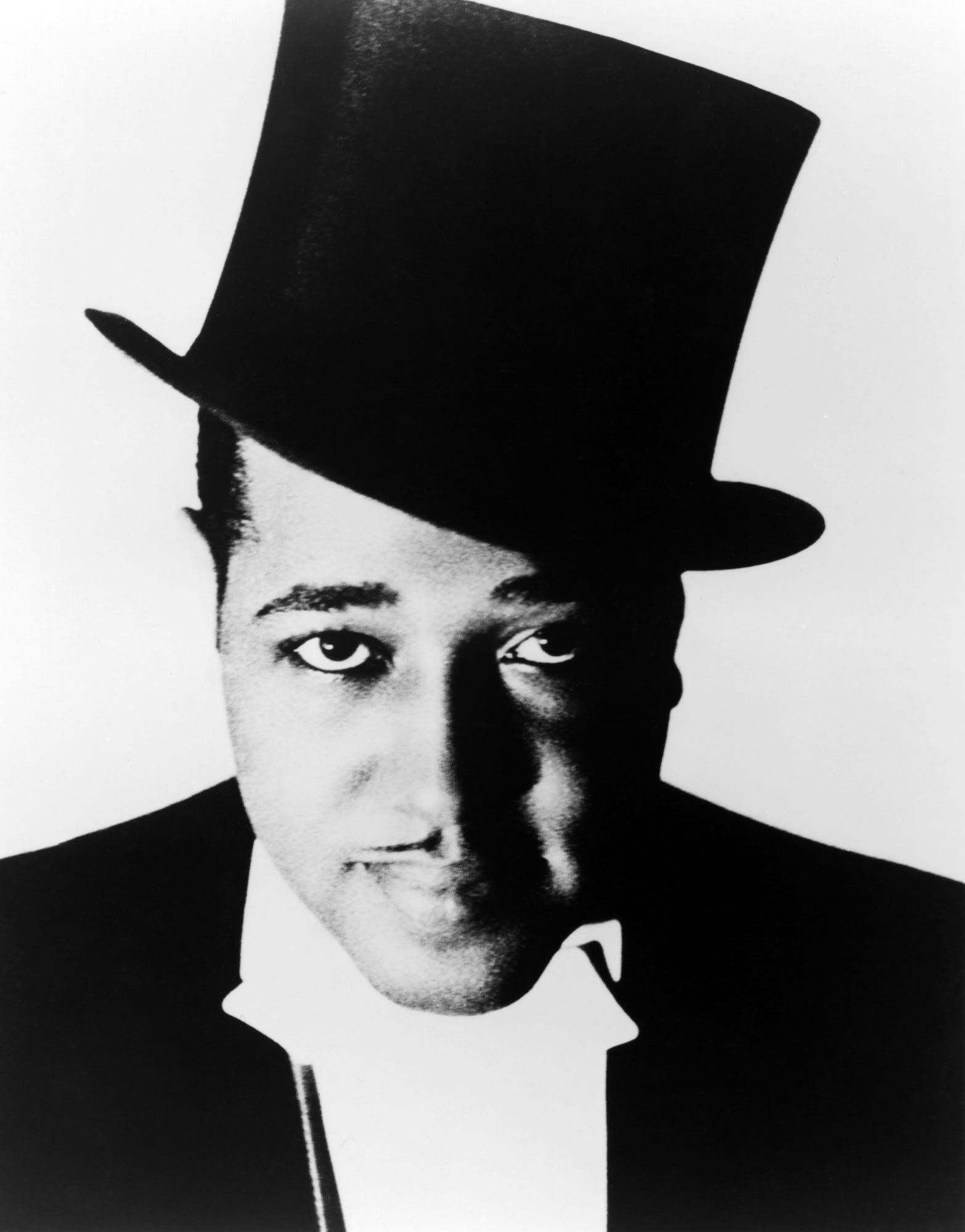
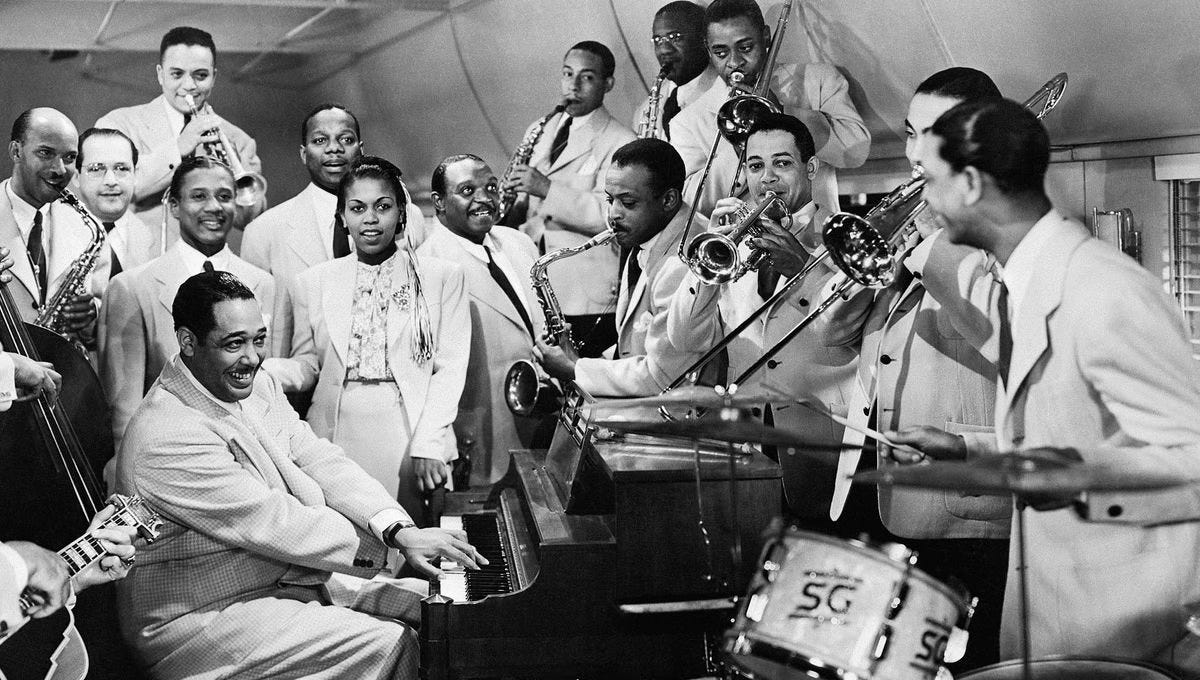
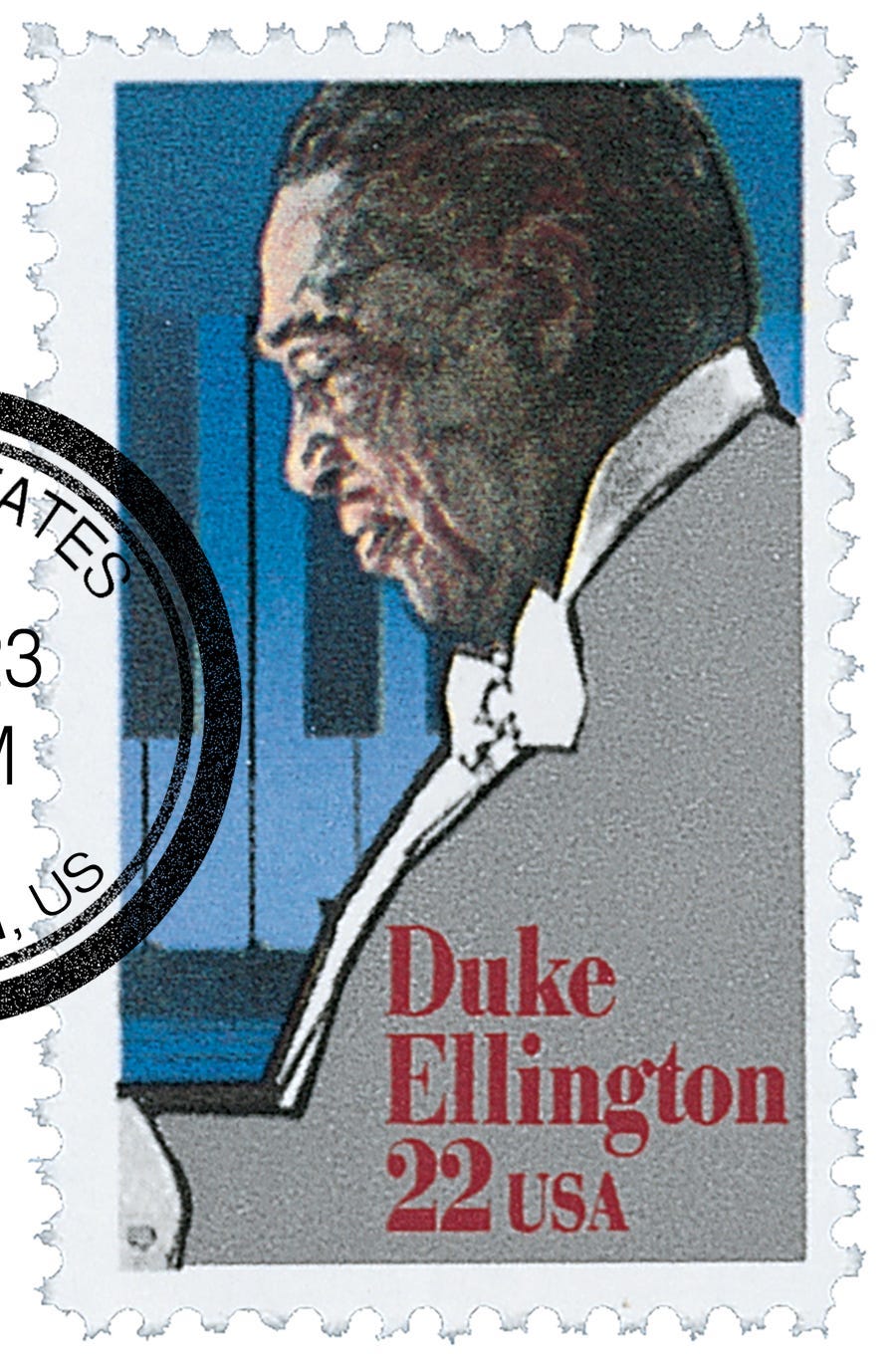
April 29th will mark 127 years since the birth of Edward Kennedy “Duke” Ellington, probably the United States’ foremost composer of the twentieth century. His greatest compositions were crafted to fit on one side of a 78rpm shellac disc, whole worlds spanning a mere three or so minutes. Duke Ellington’s uniquely American brilliance is embodied in his ability to find very good musicians, keep them in his band for decades, learning to write parts that sound as though they flowed naturally and spontaneously from the musicians themselves, elevating them to something great—a universal artistic wholeness in American vernacular. Ellington’s mastery lay in his being a hub around which many spokes turned the wheel—elegant motions where no one part was independent of the others. Let’s hope, for the prospect of actual democracy, that this is a transferable skill.
I’ve dedicated a previous episode of Red White Blues to the Duke’s longest and most ambitious piece of music: Black, Brown and Beige: A Tone Parallel to the History of the American Negro (1943) and written about his conception of “the promise of democracy”.
We’re a long way from believing that the US represents some kind of grand democratic experiment. I suspect that “Make America Great Again” galvanises the disaffected middle class precisely because it’s so unbelievable—there are no stakes in a debate about the present if no one truly believes we’re going anywhere. In the absence of an imaginable future, you just leave it to the big mouth that spews hatred at the people you already hate, a gaping maw where some kind of shared future should be. But if anything about “America” could be called great, or even American, it would be something like the music of Duke Ellington. There’s no going back, but at least we know what we’re capable of.
These are difficult questions that, if they’re answerable at all, can only be worked out in the struggle to overcome the nation, to see ourselves not as a people but as people, struggling together to make a life, wherever we are. Our starting point must be not on who belongs, but on who gets to decide.
The United States and Israel have a lot in common. Both countries came into being through settler-colonial exterminism. Both countries require a bloated class of inveterate national mythologisers, since neither developed organically and their national identities (such as they are) need constant explaining, defending and updating. Both of these national identities are bound up with race—with whiteness specifically—in a way that countries like Scotland don’t need to be, since Scotland as a nation predates the invention of “race” as a social category.
That’s not to say that Scotland isn’t fraught with questions of race and identity, or that Scottish nationalism can’t be racist (it is deeply incoherent in the most generous estimation); but having an identity in the first place, Scotland can in principle grow and change in a way that isn’t permanently defensive. It’s easier to find a niche in a place where the people who arrived before you don’t have something to prove. My own neighbourhood, Govanhill, is a case in point.
It doesn’t require a post-grad in political science to point out that, if you need to resort to the “Blood and Soil” argument, you’re probably already in an insecure position. Think of it another way: this is my flat because I live here. If someone drives me out by force because their family lived here years and years ago, I might not be able to get it back, it might be theirs forever after, and they can come up with any number of elaborate excuses why the flat belonged to them, how I can just move in with a neighbour in the next post code and why overwhelming violence was justified—but that doesn’t make it true. Nobody disputes this who isn’t part of the cult of national mythology.
In the US, the bitterest irony is that the national myth tends to exclude the very people who endowed the country with what we might call its virtues. The slogan “Make America Great Again” is actually a handy tool for interrogating that exclusion.
Start with “Make”. Who made the country? It wasn’t the founding fathers. Who continues to make it, to keep the lights on? It isn’t the founding fathers’ modern equivalent.
What is “America”? It is a continent, two continents in fact, not a country. What makes the United States “American”? Its newness, its self-invention. Some of the country’s self-inventors came unwillingly, but they eventually fought their way to a claim on some part of it as their home, for better or worse. No one gave it to them; America was won and lost and won again. Maybe lost again, and won again, and again and again.
The American empire is a threat to humanity and most other life on earth. It must be destroyed. But I wouldn’t throw the baby out with the bathwater—some things really are great about the country. There’s a wealth of art and culture, of cinema, music, food, patterns of speech, ideas and technologies sown in the substrate of American class struggle, of Black, Brown, Asian and Jewish resistance to white supremacy, growing in the cracks between cycles of capital accumulation.
The US is not and never was a white country. An outsized portion of our culture comes from minorities within American society, and almost everything good in American culture is a product of the working class creating supplements to a punishing life of labour that make life liveable. National chauvinism is an absurd dead end, but so is shame for the country of one’s birth. A country is not an individual with a personality and a rap sheet.
Idolators of the American myth may peddle a national identity in the garb of the Great Man of History, but like the trope itself, diverse multitudes are obscured in the margins. Neither the good nor the bad of the United States are reflections of you personally. On the contrary, you personally are the product of an immense struggle overflowing the centuries and transcending national boundaries.
I reject the fundamental premise of Zionism: that Jews can’t really be Americans or Scots or Europeans, that their ethnic identity precludes the possibility of “integration” into these societies, necessitating a rogue apartheid state to “protect” them. Every one of these societies already is, at least in part, Jewish. Every culture is a multi-culture—and much the better for it.
You can listen to this episode of Red White Blues here.
East St. Louis Toodle-Oo [Columbia session], 1927
Black and Tan Fantasy [Victor session], 1928
Black Beauty [Okeh session], 1928
The Mooche [Victor session], 1928
Mood Indigo [Brunswick session], 1931
Caravan [Master session], 1937
Cotton Tail, 1940
Ko-Ko [Live radio transcription], 1940
Take the “A” Train, 1940
Perdido [from Ellington Uptown], 1953
Diminuendo in Blue (Live at Newport Jazz Festival), 1956
Fleurette Africaine (African Flower), 1963
In A Sentimental Mood [with John Coltrane], 1963