
We Insist!
Prayer and Protest
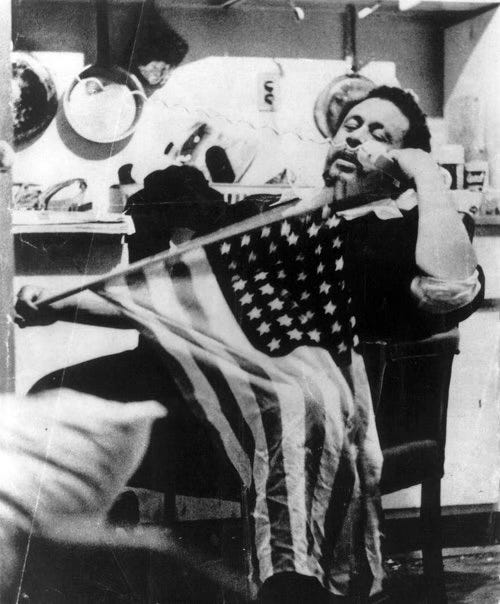
The opening theme of Red White Blues: an Anthology of America’s Music takes a snippet from a documentary about Charles Mingus, where he riffs on the pledge of allegiance:
I pledge allegiance to the flag, the white flag ... When they say “black” or “Negro”, it means you’re not an American. ... I pledge allegiance to your flag—not that I have to, but just for the hell of it I pledge allegiance ... With no stripes, no stars... It is a prestige badge worn by a profitable, profitable minority ... I pledge allegiance to see that someday they will look to their own promises to the victims that they call citizens ... Not just the black ghettoes, but the white ghettoes, and the Japanese ghettoes, the Chinese ghettoes, all the ghettoes in the world. Oh, I pledge allegiance alright; I could pledge a whole lot of allegiance!
Mingus puts it into words really well. But his music says a lot more without explaining anything. The songs I chose for February’s episode, all forms of sacred music or protest in the shape of prayer, say it too. Black American sacred music from the twentieth century is inherently “protest” music—professions of faith in anything are assertions of dignity, since one is professing to have made a free choice in the face of brute force that would have you bend to its will.
I’m not a believer but you’d be a fool to think that faith is simply fake or simply deluded or simply stupid. Religious institutions may be as venal and corrupt as any other institutions, but listen to the tenor of actually-existing resistance: it is faith in something. Then look at all the New Atheists and how many ended up beating the drums of war from the cloisters of their syndicated columns and airport paperbacks. Don’t trust anyone, believer or otherwise, who poo-poos “grand narratives” or calls you stupid for seeing the world differently—they’d sooner blow it up than share it.
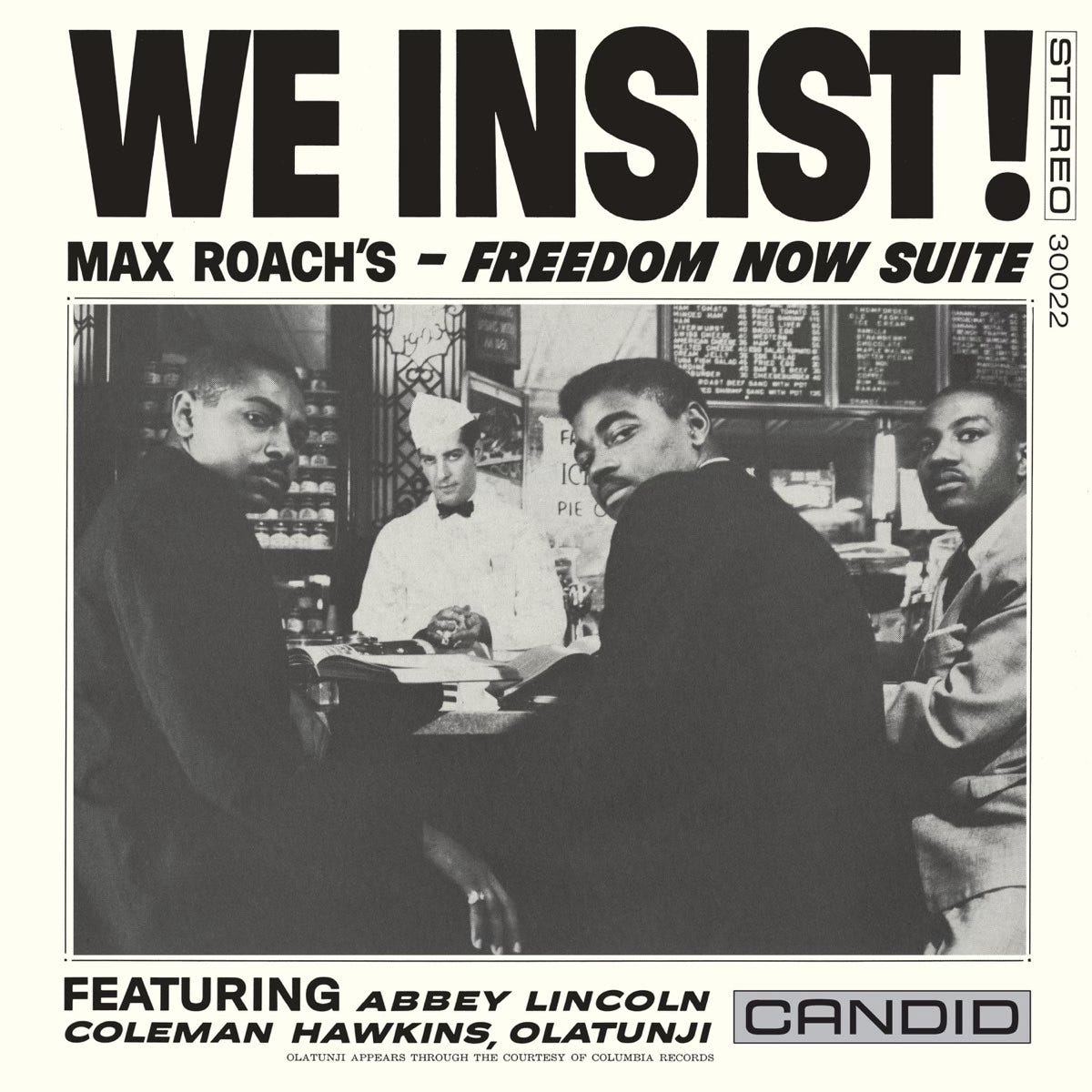
People throw around that old Marx quote about “the opium of the masses” but Marx himself pointed out in the same chapter how opium dulled pain that would otherwise be fatal. Who could undergo invasive surgery without pain relief? Music is also a pain reliever and all the songs I’ve chosen are expressions of faith, whether literal or figurative: James Baldwin’s “Precious Lord”; “I’ll Be Rested (When the Roll Is Called)”; Mingus’s “Prayer For Passive Resistance”; Max Roach and Abbey Lincoln’s screeching “Prayer / Protest / Peace”, etc. Jazz in the middle of the last century meshed with the Civil Rights Movement, that potent handshake between communities of faith and communities of principle. But jazz music didn’t make statements the way spokespeople of the Civil Rights Movement did; rather, the music embodied the feeling of being and doing what many Americans in the twentieth century were and did.
A record is not a person, but it’s as close as we can get to a conversation with what’s gone, a real kind of talking between worlds.
Under capitalism, the market is universal as the mediator between people. That mediation takes place through objects—commodities—so that relations between people become relations between things. This changes the way and the reason that things are made, since a commodity is an object produced for sale on the market at a profit. Its use to the end consumer is secondary, sometimes non-existent. The manner in which our world is produced and reproduced through the division of labour, its efficacy for creating surplus, takes precedence over the thing being produced. The world itself becomes a by-product of the accumulation of capital.
Division of labour means that workers in all fields are deskilled, separated into a chain of production where they perform ever-smaller, ever-simpler tasks requiring less and less knowledge of the overall process of production—with the exception of specialists and managers, a thin stratum set slightly apart from the rest of the class of labourers. This secures capital’s control over the method and speed of the work, but it also creates dependency in the working class as a whole, since we can’t simply turn away from capital and reproduce our everyday existence independently. Goods that were once made by the people who needed them, using skills passed down over generations, become the endpoint of a process that involves dozens, hundreds, sometimes even thousands of total strangers linked only by some abstraction called “the economy”.
This dependency doesn’t necessarily change the use value of an object.
Commodification removed music as an ordinary, everyday thing that people did for themselves or had done for them by someone within their own community—minstrels, troubadours and other semi-professionals. Before the objectification of music in the the record or broadcast, there would have to be both a personal and communal component to the experience of listening, one in which participation—dancing, singing along, beating a tambourine—was the norm. Unlike European art music, in which an audience passively consumed the work of a composer who may not be present or even still alive, and where the orchestra was the highly specialised delivery system between composition and audience, there was no such hierarchy in folk music or even popular music until the industry found its niche in the wider field of mass communications.
Within jazz, division of labour transformed these musicians into specialists, a higher stratum of worker than your uncle who sings at the wedding reception or a wandering minstrel playing for farm labourers in a ramshackle marquee for tips and drinks. But the music remained a distillation of lived experience, including those lives of past musicians who enriched the genre’s emotional vocabulary, in the shapely form of a shared cultural expression in spiritual garb. Jazz in the middle of the twentieth century still had the power and valence of hard-won moral authority. It also retained much of the character of the blues, gospel, folk music and marching bands from which it developed. So while advanced technique and vernacular idiom set jazz apart from popular music forms, requiring extensive training for the practitioners and a knowledge of how to listen on the part of the audience, the meaning being communicated was legible to those for whom it was meant.
Being a countercultural form, jazz may not have been a widely shared experience but it was (and is) a repository of a certain collective understanding, a dialect of the common language, tongues imbued with a kind of religious kinship. It gestures towards something bigger than this, here, now.
The Civil Rights Movement could not have happened as it did without mass communications, especially the tactic of passive resistance, which took for granted that newspapers and televisions would capture the violent spectacle of ordinary people getting their heads caved in for reasonably asserting their rights as citizens of the United States (and elsewhere). The tactic hinged on the power of its effect on witnesses. People would vote differently or write to their congressmen if only they knew. Of course, the movement was made up of more than just religious groups and peaceful protesters singing “We Shall Not Be Moved” en masse, though the legend peddled by mass media elides or sanitizes the more militant factions of Black American resistance to racism.
Today, there is more to witness than anyone in the twentieth century could have dreamed. If anything, you can’t get away from it. Yet it’s this very act of witnessing that stirs in us that familiar feeling of impotent rage, of powerlessness, of withering separation. Passive resistance dies in the dark, but it also dies of over-exposure. The power of a movement, its ability to endure and advance, rests on the most delicate filaments: social bonds unmediated by the market, by the state, by a culture hammered into shape according to the dictates of capital. Those filaments have been thoroughly shredded and no movement worth its salt can emerge in a society where we’re unbound from each other. So I don’t need to believe in god to know that something is missing, a void that civil-social bonds like religion used to fill.
Music makes life a little more pleasant, without any reason or explanation or deeper purpose. Music can also make life a little easier because when you add rhythm to a task or put on headphones while you allow a boss to suck your soul for a wage or you distract yourself from something physically painful with a song you know intimately, you’re using a well-honed, time-proven tool. Music helps makes sense of the world, and boy, do we ever need it to make sense. And music gives life a sense of meaning—someone across space, across time can externalise the most complex storm of thoughts and emotions, the same chaos living inside you, showing you that it didn’t kill them, at least not in time to stop them making something beautiful. So you know there are more of us out there who see it this way, you hear the call in a language you thought only you could speak.
Can music fill the void? No, definitely not. But for me, at least, it gives voice to this longing for something bigger than me. I live in hope that someone else can hear it too.
Listen to the episode here.
“Precious Lord”, James Baldwin, David Linx & Pierre Van Dormael
“Tulinesangala”, Nakisenyi Women’s Group & Béla Fleck
“I’ll Be Rested (When the Roll Is Called)”, Blind Roosevelt Graves & Brother
“Prayer For Passive Resistance” [Live at Antibes, 1960], Charles Mingus
“Triptych: Prayer / Protest / Peace”, Max Roach & Abbey Lincoln
“Adhan & Allah-O-Akbar”, Dollar Brand (Abdullah Ibrahim) & Johnny Dyani
“Come Sunday”, Eric Dolphy
“When I Lay My Burden Down” [Live at Portland, 1975], Elizabeth Cotten
“We Shall Walk Through the Streets of the City (Dirge)”, Ernest “Doc” Paulin
Interspersed with sound collage by Yours Truly