I never intended to make music for money. Though I carried a guitar with me wherever I went, it was to practise, to break out with friends and family, to please myself in those lonely moments. Music connected me with people in a way that socialising failed to do because I could either do it alone and commune with the musicians of the past whose songs I played, or I could play songs that made people happy, attentive and engaged in the here and now. Getting people to sing along has always felt like a privilege, like something special was happening. Socialising isn’t easy for people on the autism spectrum because you don’t really know where you stand, you can’t read the social cues or know what you’re supposed to do. Singing or playing, on the other hand, is a simple matter of knowing the song or being able to learn it on the fly.
When I was 19, I crossed the Atlantic with $250, a suitcase light on clothes and heavy on books, and a busted up Washburn acoustic guitar discarded by a friend (I discovered it in their broom closet, upside down, with only two strings, both green from age). The rent on my bedsit was £35 a week—this was 1998—so I had to find work.
The first job I landed was landscaping in suburban Surrey. We planted ornamental trees, trimmed hedges and scraped moss from between the brick roof tiles on top of the big house. To get up there, we had to use one ladder up from the ground, one ladder hanging off the peak of the roof and braced on the gutter, sit facing up on the ladder step and use a stiff bristled brush with an extra long handle to loosen the moss. This was December, the temperature was freezing and the drizzle soaked my jeans, turning them stiff with ice. A cloud of brick dust formed around us. My eye became swollen and painful. Grit floated in the air and landed on my cornea. At the hospital, an NHS doctor swiped it off with a surgical cotton bud and sent me off.
Next I landed a job as a kitchen porter six miles away where the only bus home stopped running 15 minutes after my shift. The chef didn’t like me and would give me awful chores to do at the end of the night, like scouring the black hob until it was silver again. The hob being deeper than my arms were long, scouring the back burners meant burning my middle to reach it. I scoured for 40 minutes before the sous chef told me that the boss was just fucking with me, it would never be silver. I had to hitchhike home near midnight, which in Surrey is no small feat.
Last, they took me on at a telesales office selling carpet cleaning services. We sat by a phone with a big yellow phone book, instant coffee and cigarettes, offering elderly people “free” consultations “in their area”. If they said yes, the salesman would drive to the house and give them the spiel. I went with him once and we bunked off, driving to Clapham where he bought a small bag of crack and rolled it into a joint, which he smoked in the car while I squirmed in the passenger seat.
Having no real skills or ways to make money and being totally unable to hold down these jobs, things got tricky. At one point, all I was eating was a couple slices of toast and green beans in a can. My cheekbones stuck out and people thought I was sick. Desperation drove me to the train station where I sat at the entrance and played all the songs I knew, all fifteen or twenty of them and some more than once, with my hat on the ground in front of me. To my surprise, the hat filled up. I made £36 in about an hour. Eventually, busking became my job.
Is a busker a professional musician? They make money doing it, sometimes they even make a living. I did for a while. Twenty-five years ago, when making money was easier than it is now, I could make enough to last me a week by singing on the street Friday and Saturday nights, 11pm to 4am. People pouring out of the pubs on their way to the clubs would crowd around in the dozens and sing at the top of their lungs: SWEEEEET CAROLIIIINE DAH DAH DAH SO GOOD SO GOOD. Or in a pub, or at a wedding. From my experience, most musicians make money like this or some other way more similar to this than, say, Taylor Swift. You learn to read a crowd, how to keep them interested, how to let them do most of the work so you don’t blow your voice out. You learn to spot trouble and to pick up banknotes as soon as they hit the coin pile. You learn to see hustlers coming and to protect yourself and your audience from them. One guy pretended to have learning difficulties, dropping a twenty in my case—then fainting. When people from the crowd would help him up, he’d reach for his twenty and grab a handful of coins at the same time. I grabbed him once and threatened him and he yelled I’M A NUTTER I’M A NUTTER. What part of the economy do these transactions occupy, unmediated as they are by the market proper? What kind of jobs are these that require as much training as a doctor—buskers and hustlers—where there are no qualifications or regulatory standards? Is busking begging? Are beggars workers too?
In a society where labor power is purchased and sold, working time becomes sharply and antagonistically divided from nonworking time, and the worker places an extraordinary value upon this “free” time, while on-the-job time is regarded as lost or wasted. Work ceases to be a natural function and becomes an extorted activity, and the antagonism to it expresses itself in a drive for the shortening of hours on the one side, and the popularity of labor-saving devices for the home, which the market hastens to supply, on the other. But the atrophy of community and the sharp division from the natural environment leaves a void when it comes to the “free” hours. Thus the filling of the time away from the job also becomes dependent upon the market, which develops to an enormous degree those passive amusements, entertainments, and spectacles that suit the restricted circumstances of the city and are offered as substitutes for life itself. Since they become the means of filling all the hours of “free” time, they flow profusely from corporate institutions which have transformed every means of entertainment and “sport” into a production process for the enlargement of capital. By their very profusion, they cannot help but tend to a standard of mediocrity and vulgarity which debases popular taste, a result which is further guaranteed by the fact that the mass-market has a powerful lowest-common-denominator effect because of the search for maximum profit. So enterprising is capital that even where the effort is made by one or another section of the population to find a way to nature, sport, or art through personal activity and amateur or “underground” innovation, these activities are rapidly incorporated into the market so far as is possible.
- Harry Braverman, Labor and Monopoly Capital (1974)
Before the mass production of recorded and broadcast music as an affordable consumer good, musicians either went through formal training in the academy or informal training in unofficial apprenticeships with more experienced practitioners of an instrument or vernacular style. This method of producing music workers persisted for decades into the age of music as a consumer good produced at mass scale.
The academy offered training in music theory and composition, arrangement, orchestration, and performance for the concert hall. A musician or composer was primed for the highly specialised field of art music in all its entanglements with the wider economy, which were often limited to consumption by a small group of people with a respectively specialised taste or fluency in art music. This didn’t make the music necessarily better; it simply added a barrier to its legibility for the general public (ie. the working class). You can argue over the chicken or the egg coming first, but either way, specialisation and signifiers of class position were mutually constitutive and reinforced one another.
Before American vernacular musics like jazz, ragtime, blues, folk or old time became art music, the only way to study them was to actually play them with other people or listen to recordings and learn from there. Again, informal apprenticeship predominated decades into the advent of records and radio because the nature of vernacular music is that it speaks in slang—and to use slang you’ve got to speak to somebody, more specifically somebody who understands the lingo (unless you don’t actually want to be understood, but we’ll come back to that another day). The result isn’t all that different from the music emerging in the rarified heights of the academy: it came down to legibility. You had to understand something about hearing (even just intuitively) before you could understand what you were hearing.
The practitioners of both art music and vernacular music were not professionals in the strict sense: that is, their fields were not professions so much as services—rendered, in art music for the aristocrat and the bourgeois, and in vernacular music for smallish groups characterised by ethnicity, affinity, locality, or a mix of the three. Musics largely emerged from the classes they were meant to service, neither of which were professional classes as we understand them today. Both the production and consumption of these types of music signalled something about those classes, the type of knowledge one garnered as part of the class and the valence of intra-class identity. But neither music forms were productive, in the limited sense that they played little or no part in the accumulation of capital. One party has money to pay a musician for the experience of hearing their music; the other party has music to exchange for money (or whatever is on offer). It’s a closed circuit. Each party can repeat the transaction, sure, but the transactions themselves don’t lead to further transactions, to returns on investment, to the enlargement of the original outlay, which is the formula of capital accumulation.
This came later, when music was objectified as a recording or broadcast and alienated from the performer and the performance. Capital, in this arrangement, interjected itself as the middleman between the musician and the purchaser of a record or radio. For the capitalist, a commodity can be anything as far as they’re concerned, as long as there is sufficient profit on their investment. Music as a profession emerged as a consequence of capital seizing the means of production and distribution, placing themselves as a barrier between the producer and the consumer, making both parties reliant on the capitalist for any exchange to occur. Harry Braverman’s point about the debased quality of cultural commodities in the quote above might be debatable, but there is no doubt that the intercession of the market fundamentally changed the way, the reason and the type of music that was made by transforming music into a commodity and its producers into hired labour.
If you want to make money from music (busking notwithstanding), you’ve got to market yourself. Every musician comes up against this reality: being a professional means being a salesperson, enmeshed in a circuit of value production—from digital platforms to physical venues to public liability insurance to the hours getting started in the first instance, usually funded by working some shitty job—that benefits you least of all. To sell, first you’ve got to buy. You’re immediately compelled to become a petit-bourgeois, a small business owner competing with huge corporate rivals who wield monopsony purchasing power that translates into a market monopoly. “Being your own boss” in this instance means purchasing your own labour power and squeezing your “hired labour” to get the most surplus value you can muster.
I don’t know how to do that and I never have. Some of the best musicians I’ve ever met were terminally incapable of meeting the demands of professionalisation. Of all the jobs I’ve done, the highest paying music gigs were by far the worst, the hardest work, the most embarrassing—a real departure from the trend in non-music jobs where the less I got paid, the harder I was expected to work. The most successful musicians I’ve known have been some of the most superficial, the most mediocre, the downright corniest—but they were damn good at selling themselves. And not to audiences but to the people who actually “matter” in the music business: managers, labels, promoters, etc. Music relied on an “attention economy” long before social media or its vapid terminology wormed its way into our working lives. Music, as always, foreshadowed the world to come.
I put together this month’s episode thinking about those musicians engaging with American vernacular musics like jazz or blues and how almost all of them had non-traditional routes into their “careers”. Many were buskers; some we have very little knowledge of (like Bayless Rose and his record “Frisco Blues”), since Black music recordings in the 1920s were largely the result of labels scrambling to find artists to make records in keeping with increasing demand. This meant that urban labels sent recording engineers to the rural parts of the US, putting advertisements in local newspapers with an open call to audition, with those deemed saleable given the opportunity to record a couple of songs. Some of the resulting records captured musicians who subsequently made a living performing and recording; others remained in relative obscurity.
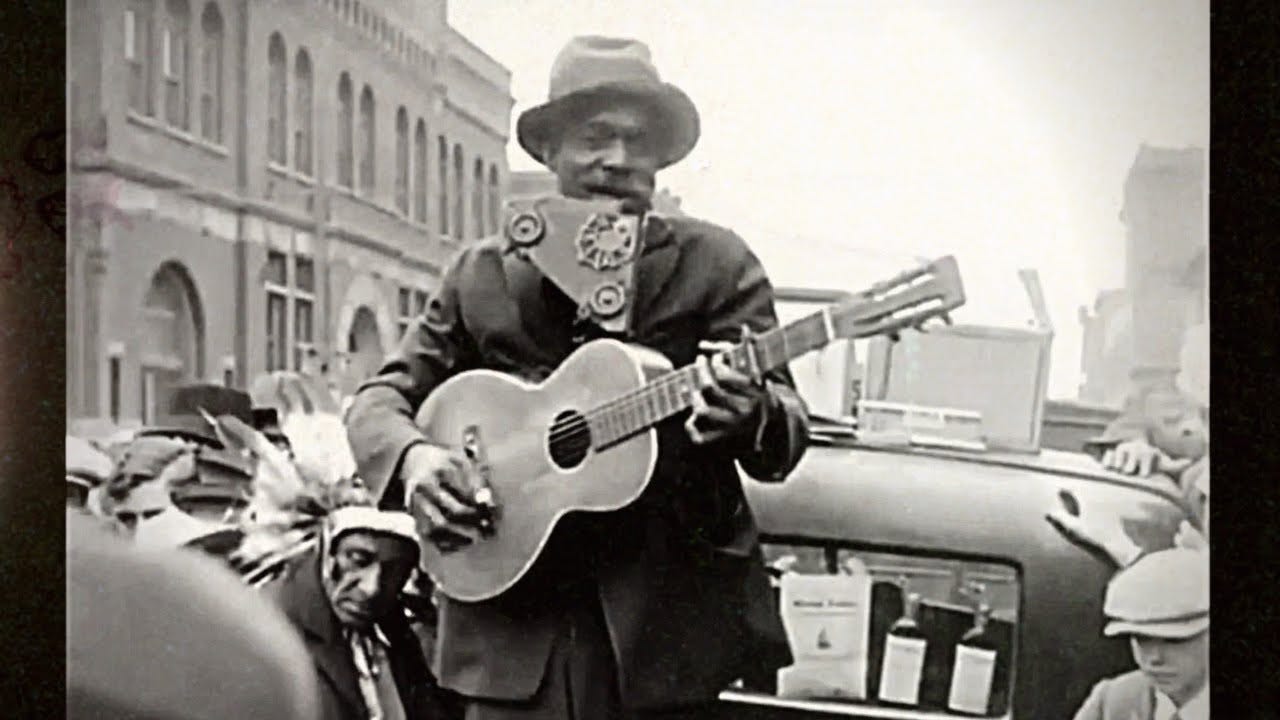
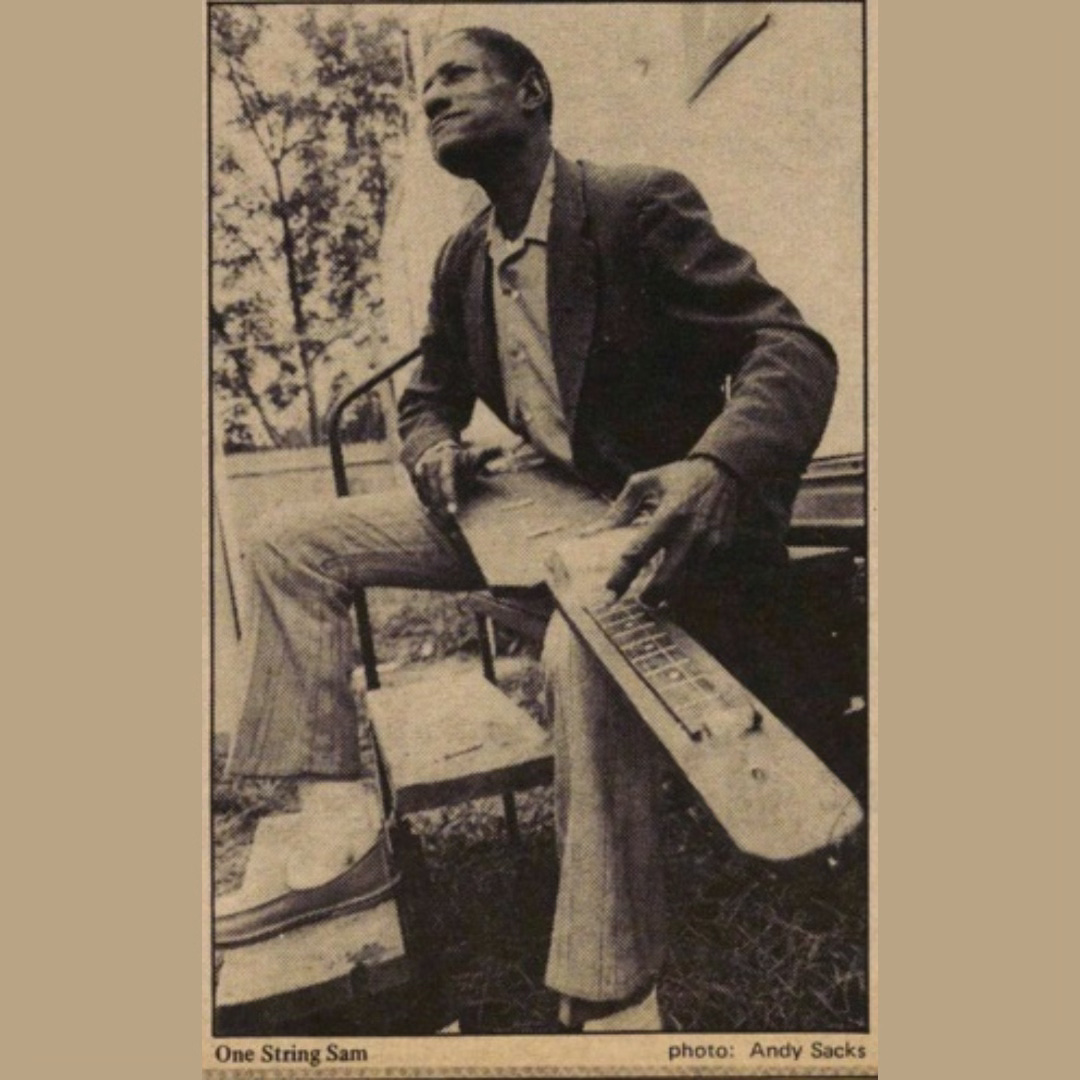
Some of my favourite records in this episode are from buskers: Henry “Ragtime Texas” Thomas’s “Run Mollie Run” is as close as you’re going to get to hearing nineteenth century dance music played by a musician from the nineteenth century. Henry Thomas was basically a hobo who rode boxcars from place to place, playing on the street or in bars for tips. “My Baby Ooo” by One String Sam is not as old as it sounds (1956) but the guy is playing a homemade diddly bow, a single-stringed fretless instrument he played with an empty glass jar as a slide. This is one of his only two recordings; he made his living busking on the streets of Memphis. The Reverend Gary Davis became a legend in New York for his tutelage of folk-revivalist fingerstyle guitarists like Dave Van Ronk (himself Bob Dylan’s mentor) and his fixture as a Harlem busker. He’s playing his own unique arrangement of Scott Joplin’s quintessential ragtime masterpiece, “Maple Leaf Rag”.
Other recordings, like the jug bands and “blowers”, range from modernist masters like Coleman Hawkins in a studio-only band working under the title Mound City Blue Blowers to the Depression-era covers band The Washboard Rhythm Kings, where the musicians are cutting these sides purely as a kind of side hustle. Like Louis Armstrong’s Hot Fives and Sevens, these bands didn’t exist outside of the studio. Recording was just another gig, another small paycheque to keep them going until the next one. We don’t call it “the gig economy” for nothing.
It was precisely the lack of a music profession that allowed the regional vernacular culture of working class Americans to be captured and preserved. One of the records I’ve chosen, Lucille Bogan’s “Shave ‘Em Dry” (definitely NSFW) was likely recorded for private consumption, since no label would ever release a song sung by a sex worker about the intimate particulars of sex work (her frequent profanities and eruptions of laugher suggest that Bogan didn’t intend it for a wide audience either). Similarly, Geeshie Wiley’s “Skinny Leg Blues” takes the blues genre’s raunchy innuendo on a sharp and sudden turn when she sings “I’m gonna cut your throat, baby / And look down in your face”. This isn’t even “popular music” in the sense that folk music is a kind of “popular music”.
Of course, many Black American musicians of the early twentieth century weren’t rural amateurs or even folk musicians. The composer James Reese Europe treated jazz and ragtime as an art music, insisting that it be played by a full-scale orchestra (though not of the symphonic variety). His recordings are some of the earliest jazz records in existence, though his music is usually labeled as ragtime. Even I’ve been guilty of overlooking Europe: in the second episode of Red White Blues, I described The Original Dixieland Jass Band’s 1917 recording of “Livery Stable Blues” as “the first jazz record”, which isn’t strictly true if you count recordings like “Memphis Blues” and others he cut with his 369th Infantry “Hell Fighters” Band, made during the First World War. Likewise, James P. Johnson was a composer and pianist who straddled the world of rent parties, musical theatre and publishing. While he’s best known for being the pre-eminent master of Harlem stride piano, he composed operas and popular songs played by other artists. He was as close to a professional as any of the featured artists in this episode.
The opening track is a modern recording of Erik Satie’s music for the ballet Parade from 1917. This piece is, in some ways, an outlier, since it is high art music, part of the Dada movement, a ballet, from France, etc. But if you listen, you’ll hear that part of Satie’s Dada approach, meant to antagonise elite tastes and spur on revolutionary challenges to class power, was to incorporate music not considered appropriate for the concert hall: there are frequent strains of jazz, ragtime and popular song throughout the fifteen minute duration of Parade.
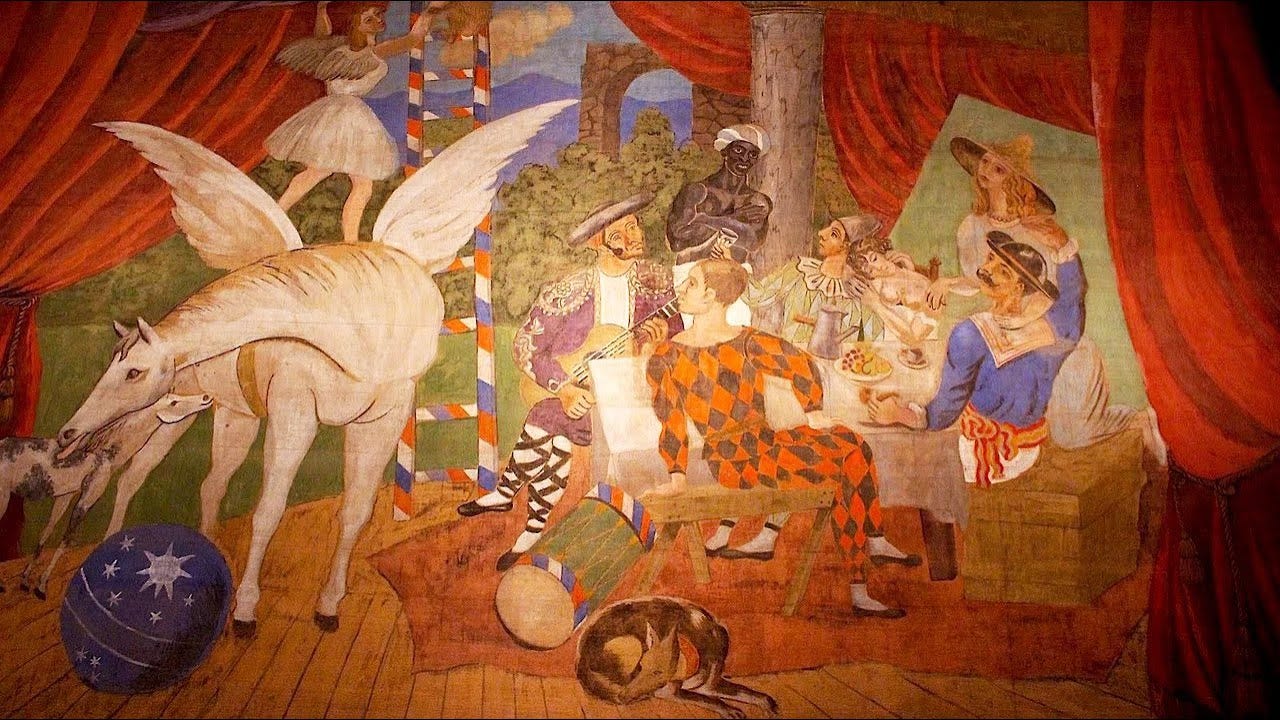
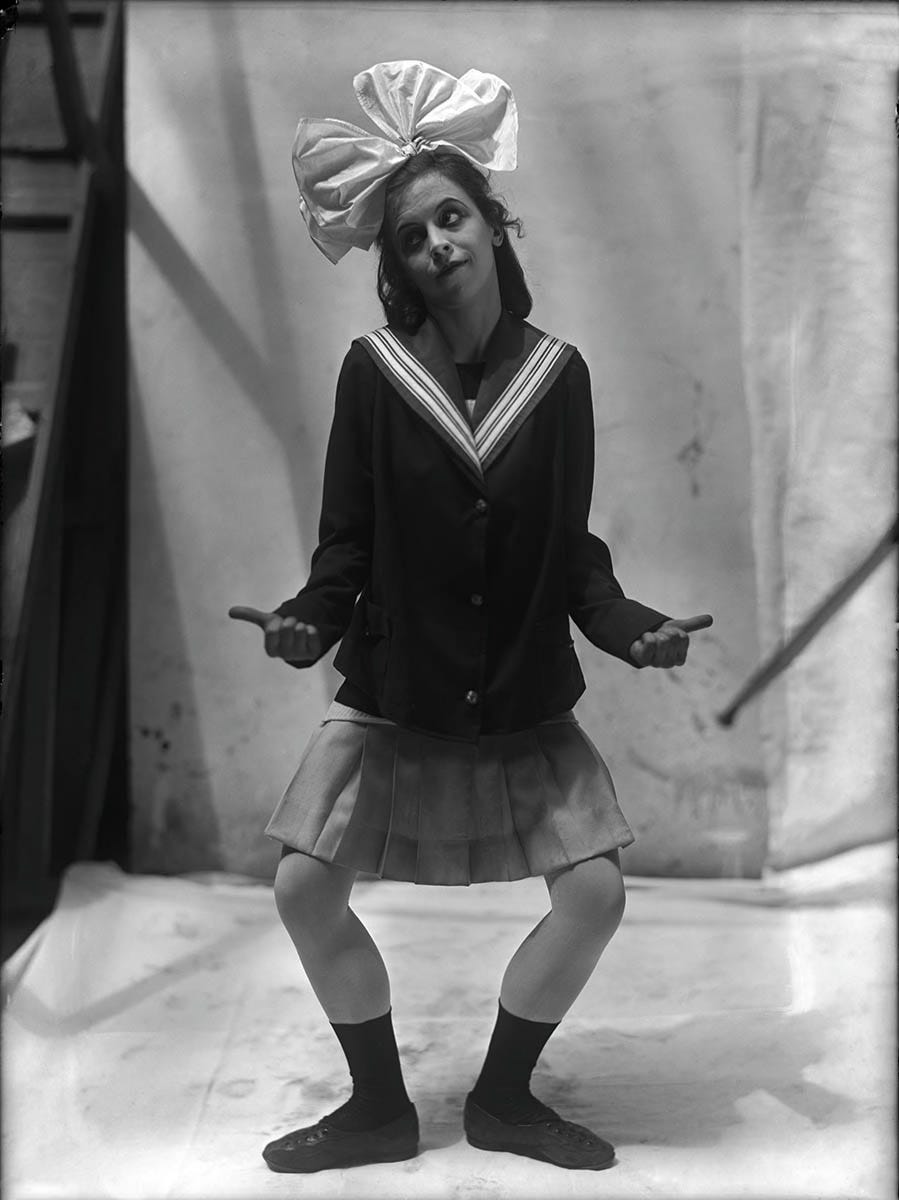
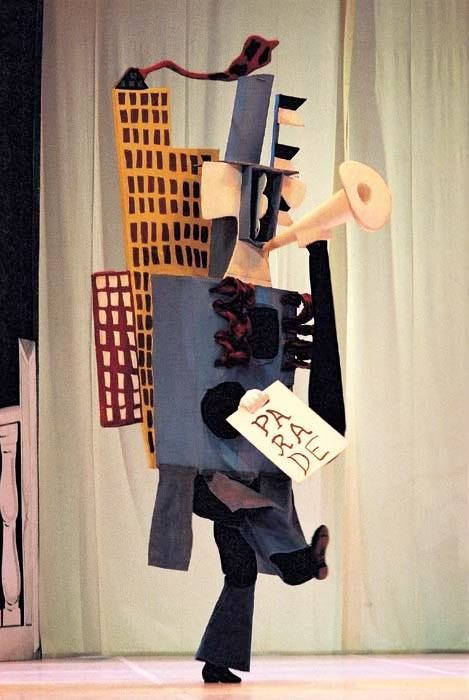
Erik Satie is now considered a great composer, but in his own time he made a living playing piano in barrooms of suburban Paris, where his function was to entertain. Even his compositions, appreciated as they were by a progressive-minded minority of the late nineteenth and early twentieth centuries, were rejected by the kingmakers of French music who commissioned (and paid for) music works. A large number of Satie’s works went unpublished, discovered among his possessions only after his death. Parade marked a high point in Satie’s career, when he was able to collaborate with Jean Cocteau, who devised the one-act scenario of the ballet; Pablo Picasso, who constructed the set, painted the curtain backdrop and created the elaborate and profoundly impractical painted cardboard costumes worn by the dancers; and Serge Diaghilev, leader of the Ballet Russe, who danced the ballet. The poet Guillaume Apollinaire coined the term “surrealism” describing Parade in the show’s playbill.
Parade takes place on a busy Paris street, in front of a theatre. A ragtag troupe of performers take to the street to promote the show, in increasingly desperate attempts to draw in a crowd. There are ocean liner foghorns, clicking telegram keys, a typewriter, police sirens and even gunshots incorporated into the music. Parade culminates with the troupe making an extraordinary and frankly insane spectacle, with a huge crowd looking on. The spectacle comes to a close and the crowd disperses, believing they have actually seen the show, much to the chagrin of the performers, who did it all for nothing.
Without laying it on too thick, I think you should be able to pick up on the allegory. If not, have a look at what musicians are up to these days when they’re not making records or playing in a room full of people.
Satie: “Parade: Ballet Réaliste” [1917], Orchestre Symphonique et Lyrique de Nancy
“Memphis Blues”, James Reese Europe / Jim Europe’s 369th U.S. Infantry “Hell Fighters” Band
“Carolina Shout”, James P. Johnson
“Boodle-Am Shake”, Dixieland Jug Blowers
“Run, Mollie, Run”, Henry Thomas
“Hello Lola”, Mound City Blue Blowers
“St Louis Blues”, The Washboard Rhythm Kings
“Frisco Blues”, Bayless Rose
“Cocaine Habit Blues”, Memphis Jug Band, Hattie Hart
“Skinny Leg Blues”, Geeshie Wiley
“Shave ‘Em Dry (II)”, Lucille Bogan
“Don’t Tear My Clothes”, Washboard Sam
“My Baby Ooo”, One String Sam
“Memphis Shakedown”, Carolina Chocolate Drops
“Maple Leaf Rag”, Rev. Gary Davis